
5 Associate Insights from Today’s Pressures, Tomorrow’s Possibilities

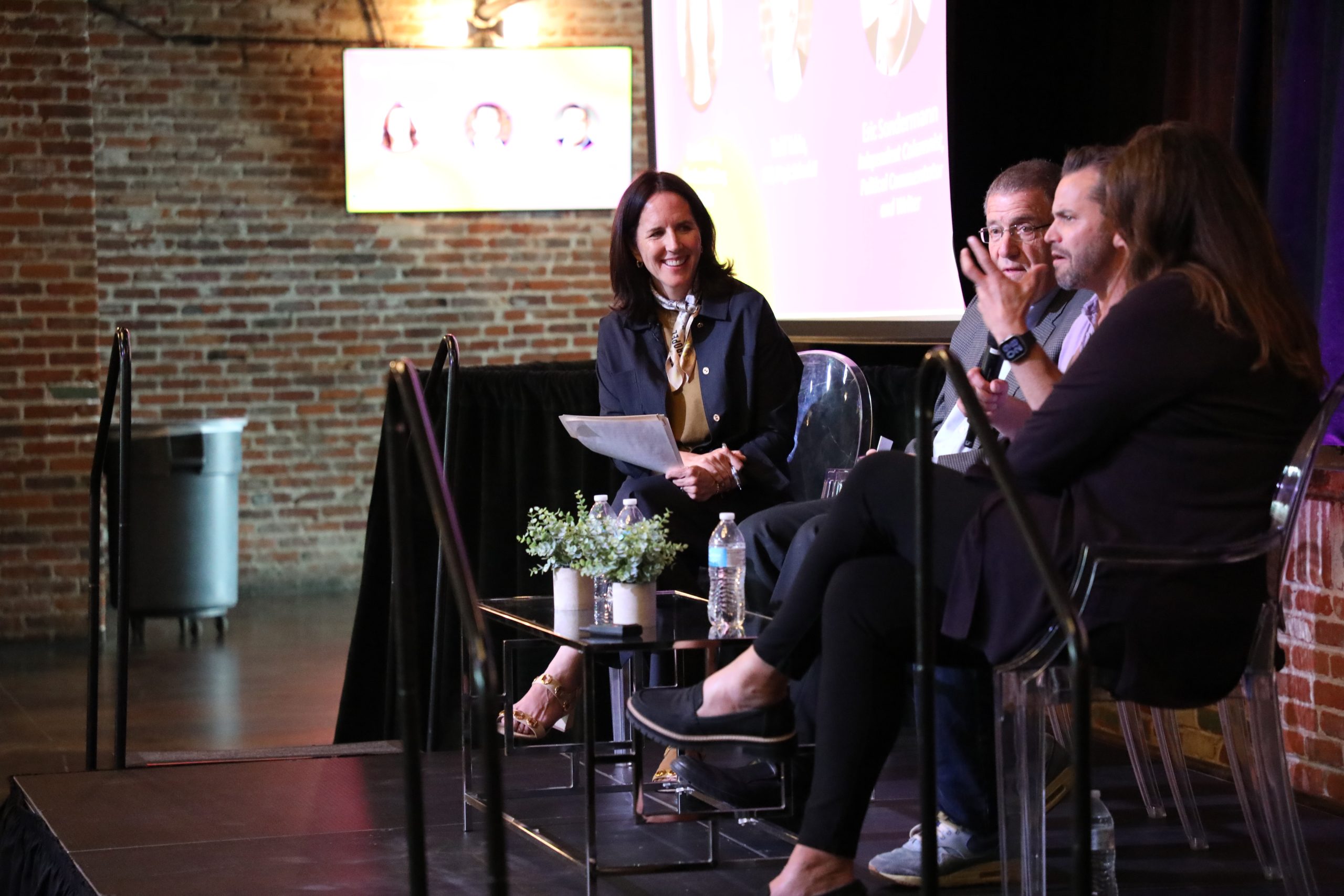
At Elevate, our Associate event in June, our CEO Ann Ayers invited three panelists for a conversation on how transformative technologies, shifting geopolitical landscapes and VUCA (volatile, uncertain, complex and ambiguous) conditions are changing leadership priorities.
Today’s Pressures, Tomorrow’s Possibilities featured Pam Jeffords, Founder & Partner at BE Labs; Todd Tobin, CTO at Magic School AI; and Eric Sondermann, Independent Columnist, Political Commentator and Writer. In the weeks since Elevate, I’ve caught myself returning to this discussion more than once. These five takeaways continue to shape how I think about leadership, learning and the future of work.
#1 – Now Is the Time to Reimagine Roles
Headlines about AI-driven job loss and gains are everywhere. The consensus from our panelists is that, while most jobs won’t disappear, they will be transformed. Boston Consulting Group echoes this sentiment, estimating that 50% – 55% of jobs in the US alone will be reshaped by AI in the next two to three years.
Todd shared an example of how his Chief of Staff built an AI agent to handle the part of her role that once consumed most of her days: moving information across people and systems. That freed her up to be part of the strategic conversations she always wanted to participate in and rarely had time for.
Todd’s tip is to help staff move through the fear of being replaced by AI by inviting them to think about who technology can enable them to be or what it can help them do differently.
Associate Takeaway: How are you using AI to fuel your own job transformation and engagement – and how can you coach others to do the same?
As a practical tip, Ann suggested mapping your job responsibilities onto a 2×2 grid. One axis charts skill (from what you’re not so great at to what you’re very good at); the other charts passion (from what drains you to what you love). Find the intersection of what you are good at and don’t enjoy. Then, challenge yourself to see what AI can take off your plate.
#2 – Integrate Meaningful Learning into Un-cuttable Trainings
When budgets tighten, development programs are often scaled back. This reaction can damage employee morale and stall the skill building that your organization will require in the future. While we cannot always maintain our budget levels, there are ways to creatively integrate learning and development into your systems.
Pam recommended evaluating your mandatory trainings – technology, compliance, legal or otherwise – and looking for ways to embed your values and in-demand skills directly into these programs. The trainings can become more impactful for your staff and reinforce the behaviors and competencies that matter most, even when time and money are scarce.
Associate Takeaway: Are your required trainings out-of-the-box? If so, it may be time to review them and intentionally connect the content to your organization’s needs.
For example, take an email security training and weave in practice time for managers to coach direct reports after an incident.
#3 – Critical Thinking Is the Complement to AI
Eric shared this headline with our attendees, emphasizing the idea that in an age of information overload, the ability to separate what information is important and what is just noise will be one of the biggest differentiators of success.
Todd and Pam built on this idea, with Todd pointing to the value of asking better questions, staying curious and deliberately considering the opposite of your own position. Pam encouraged attendees to think about how they’re developing leaders. Executives have often confused leadership with being right. Her perspective is that true leadership is about helping others arrive at an answer on their own.
Associate Takeaway: How are your development programs helping individuals open themselves up to new perspectives, analyze information and sharpen critical thinking?
Emergenetics gives you a built-in tool for this work. Use it to help staff proactively consider distinct ways of thinking and behaving and design training simulations that promote thoughtful problem-solving.
#4 – Create the Containers for Brave Spaces
Our panelists pointed to a real risk in today’s workplace: As people increasingly divide themselves into groups, it feels riskier than ever to have honest, difficult conversations. Yet, innovation requires us to surface differing opinions and perspectives.
Pam suggested changing the types of questions leaders ask to promote open dialogue. After sharing a new vision or a major transition, rather than asking, “What questions do YOU have?” ask instead, “What questions will your teams have? What questions will our clients have?” Shifting the focus to another group’s needs often makes it easier to speak up.
This reframing is not about prioritizing the other group’s input or appealing to the Social Attribute. It is a leadership strategy that gives people a safer entry point for raising concerns. By inviting perspectives beyond their own, leaders can more quickly demonstrate openness to challenge and make room for contrary points of view.
Associate Takeaway: Psychological safety takes time to root inside an organization. Leaders can accelerate it by creating conditions where individuals feel safe challenging ideas and sharing concerns.
Identify a few reframed questions through the Emergenetics Attributes to share with leaders, so they can proactively surface contrary perspectives. Examples could include:
- What do you think others may be skeptical about?
- What steps are missing from our approach?
- Who else should we consult?
- What other ideas does this topic inspire?
#5 – Elevate Listening Over Positionality
To build trust in the workplace, a few skills rose to the top. Eric invited organizations to train the workforce to listen more and talk less. He reinforced the importance of trying to understand one another and to win fewer arguments.
Todd added that we should celebrate when new information or insights have shifted someone’s thinking. There is so much to learn from those who are pushing back when we embrace the idea of learning over being right.
Associate Takeaway: What practices or trainings are you introducing to help leaders and employees enhance their capacity to listen?
Consider elevating coaching skills within your training initiatives to empower staff to seek understanding before trying to be understood themselves.
Significant external forces are reshaping every one of our workplaces, and I’m encouraged by how much our Associate community can do to empower people to navigate the shift. You already have the tools to help employees embrace diverse perspectives, sharpen critical thinking and hold space for scratchy conversations. Those are the starting points to help your organization thrive amid uncertainty and change.
How can you help your company through this time of transformation? Let’s connect about new solutions to support your teams and leaders!
 Print This Post