Most leaders are trained to read the board. The ones who see the right moves earliest are reading something else entirely — the players, the field, the signal that hasn’t resolved into data yet. That capacity is not instinct. It is a perceptual discipline. And it is the most at risk of being quietly outsourced away.
It was a rainy Sunday. My two children had already strategized before the Monopoly board was fully set up. They had identified their target markets, divided the board between them in hushed negotiation and were mildly, cheerfully confident that I was not a serious threat.
They were not wrong about the board. I kept landing on the properties nobody wanted. They made the kind of jokes only children who are certain they’re winning will make. Mostly about my age.
What they missed — what they could not see, because they were so fluently executing their own strategy — was that I was not reading the board at all.
I was reading them.
I watched the shape of their attention. Where it narrowed, where it widened, what they stopped tracking once they felt secure. I watched the small negotiations between them, who deferred, who pushed, where the alliance was teetering. I noticed when their confidence shifted from alert to complacent. And quietly, without announcing it, I built hotels on the properties they had decided didn’t matter and waited…
“I wasn’t reading the board to ascertain how to win. I was reading and anticipating the players — being led fully by perception and prescience.”
Patience is the word I want to stress here. Not patience as temperament. I’m aware that playing Monopoly with a 10- and 11-year-old requires something closer to an act of will. Patience as a perceptual discipline: the capacity to hold an early pattern without forcing it to resolution before it is ready. To let what you are sensing mature into something that can be acted on precisely, rather than prematurely.
I am telling you this story because it contains, in compressed form, the entire argument of this piece. And because it names something that no dashboard, no analytical framework and no AI pattern-recognition system currently replicates.
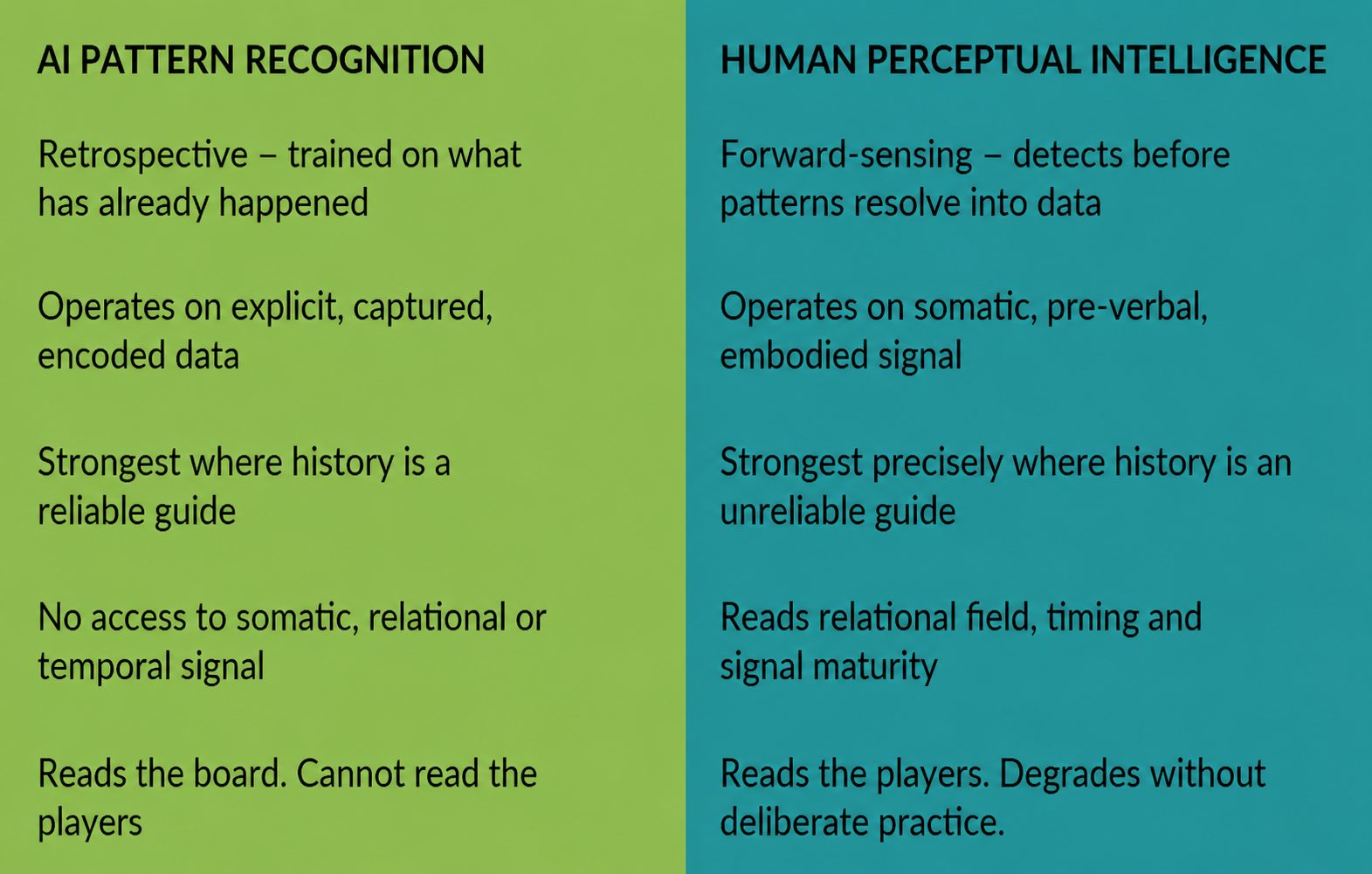
AI reads the board. It cannot read the players in real time.
This simple distinction — board versus players — is worth pulling apart carefully. Monopoly is an easy analogy. It is the central perceptual gap in how most leaders are currently operating. And it is the gap that the AI-in-leadership conversation, for all its philosophy, is almost entirely failing to name.
Here is what AI pattern recognition actually does: it finds regularities in historical data. It is trained on what has already happened, what has already been legible enough to be captured, encoded and learned from. In domains where the future reliably resembles the past, this tool is powerful. Better than human analysis.
However, the players are not historical data. The players are alive, reading the situation in real time, making micro-adjustments that haven’t turned into decisions yet, carrying assumptions and biases that won’t appear in any dataset because they haven’t yet produced an outcome. Reading the players requires a different instrument entirely — one that operates on somatic signal, relational field and temporal awareness. One that can sense when a pattern is in its arc, not just what the pattern is.
That instrument is not artificial. It is human. And it is, at this particular moment, being systematically undertrained in part because we have confused the board with the game.
The most effective decision-makers rapidly recognize patterns.
Gary Klein spent decades studying how expert decision-makers actually make decisions, analyzing what unfolds perceptually in real time and not how they describe them after the fact. Across the fields of military command, firefighting and critical care, he found a consistent pattern: the most effective decision-makers were not comparing multiple options or conducting exhaustive analyses. Instead, they were recognizing patterns, rapidly classifying situations and mentally simulating a workable course of action based on prior experience.
He called this recognition-primed decision-making, or the ability to read a situation as an instance of a familiar pattern before deliberate analysis begins. What I would add, from both the research and from my own clinical and leadership practice, is this: the most consequential patterns are not always in the situation. They are read in the people. I’ll share an example.
A few weeks ago, a colleague came to me in confusion and asked what I thought would happen in a leadership situation she was navigating. I shared two possible scenarios and described them in some detail, which she corroborated as accurate. It was the sort of detail that I could not have known given the information she had shared with me. A few weeks later, she let me know the first scenario had played out exactly as I had described.
What gets labeled extrasensory in moments like that is not psychic. It is field reading powered by deep observation, pattern recognition that operates below the threshold of conscious analysis and years of practice learning not to override what arrives before language does. It is a human capacity. And it is precisely the capacity that conscious leaders most need — and most rarely develop deliberately.
Reflecting on my Monopoly experience, my children were not inattentive. They were, by any reasonable measure, highly focused. They were simply focused on executing their own pattern, which meant, without realizing it, they stopped receiving signals from the environment around them. From me, specifically. They had decided what I was doing had no effect and stopped checking whether they were right.
This is what perceptual narrowing looks like in high performers. It’s not carelessness or incompetence. Executing a familiar strategy with too much confidence carries a hidden cost—the steady narrowing of attention. The more certain you are of your pattern, the less you are reading the players. And the less you are reading the players, the more exposed you are to the one who is not just reading the field but anticipating it.
“The more certain you are of your pattern, the less you are reading the players. And the less you are reading the players, the more exposed you are to the one who is.”
Outsourcing pattern recognition to AI leads to atrophy.
Which brings me to the problem hiding inside the solution.
When leaders outsource pattern recognition to AI — even selectively, even thoughtfully — something happens that is rarely named. The perceptual muscle that detects early, weak and non-obvious signals begins to erode. Not dramatically. Not immediately. Systematically, the way any capacity deteriorates when it is consistently bypassed in favor of something faster and more legible.
Cognitive offloading research has established a consistent pattern: when we rely on external tools to perform cognitive work, the underlying internal capacities tend to weaken over time (Risko & Gilbert, 2016). The brain does not lose the ability outright; however, reduced use leads to diminished encoding, retrieval and fluency.
The perceptual capacities most relevant to leading under uncertainty — the felt sense of offness, the early read of a team’s actual state versus their stated one, the timing sensitivity of knowing when a decision is ready and when it is not — are exactly the capacities being quietly assigned to AI as it becomes the default pattern-detection layer. However, these capacities remain beyond current AI systems because they rely on types of signals that have not been captured, encoded or translated into a form machines can process.
Attuning to patterns in people may cause discomfort, which means it’s working.
Finally, I want to name something that usually goes unnamed in conversations about perception and leadership. Leaving it unnamed does a kind of disservice to the power of the capacity.
Attuning to patterns in people at this level is not comfortable territory. There is something in deep observation—staying with how someone’s attention moves, noticing what they stop seeing, sensing the interaction before it is spoken— that can feel voyeuristic if not held with care. It seems too close. Beyond what you were invited to see. Even more so, you become less attuned to you. And that is the frightening part.
I have sat with that discomfort in my own leadership. And what I have come to understand is this: the discomfort is not a sign that something has gone wrong. It is a sign that something is working. Perceptual intelligence at this level requires a quality of presence that most professional environments actively train out of us because it is a great deal more comfortable and less exposing to read the board. The board does not mirror. The board does not require you to hold what you are sensing with both precision and care.
The players do. There is a hidden responsibility with perceptual intelligence. And that is exactly what makes this a leadership capacity rather than a surveillance one. The intention behind the perception is everything. Used without care, this level of attentiveness becomes manipulation. Used with care, and with the patience to let what you sense mature before you act on it, it becomes the living capacity that conscious leadership has always been pointing toward, without quite having the language for it.
Pattern recognition is a human superpower in the age of AI.
The conscious leadership implication is direct.
In an environment where AI is increasingly handling retrospective pattern detection, the human perceptual capacities that AI cannot replicate become more strategically valuable, not less. The leader who can feel a room before the room arrives, sense a team’s real state before it surfaces in behavior, feel the timing of a decision before analysis confirms it — that leader is not operating on instinct in some dismissible sense.
They are operating on a perceptual instrument that no current AI system possesses. The question is whether they are developing it deliberately through practice, through attention, through the slow discipline of letting what they sense complete before they override it, or whether they are letting it quietly atrophy while they wait for the dashboard to confirm what they could have sensed weeks earlier.
My children are excellent strategists. I trained them well. They will be formidable in whatever domains they choose. But on that rainy Sunday, they were reading the board while I was reading them. Patience, perception and a few well-placed hotels did what analysis alone could not.
The most consequential leadership edge right now is not a better model. It is an earlier, more accurate perception of what is already present in the room, in the team and in the moment before it becomes obvious and before it becomes a crisis.
The signal is already there. The question is whether you are still capable of receiving it — or whether you have outsourced that capacity to something that can only read the board.
RESEARCH REFERENCES
Damasio, A. R. (1994). Descartes’ error: Emotion, reason, and the human brain. Putnam.
Klein, G. (1998). Sources of power: How people make decisions. MIT Press.
Polanyi, M. (1966). The tacit dimension. Doubleday.
Risko, E. F., & Gilbert, S. J. (2016). Cognitive offloading. Trends in Cognitive Sciences, 20(9), 676–688.
Discover how Emergenetics [1] helps leaders see what others miss, before it becomes a challenge. Connect with our team to learn more.